

Stanford Prison Experiment What the Guards Were Told First
In August 1971, the Stanford guards were told they could create fear. The tape survives. What it means is still argued. Zimbardo, 2018. Le Texier, 2019
What were the Stanford prison guards told?
At an orientation the day before the prisoners arrived, Zimbardo told the guards they could not hit the prisoners. Then he said they could create boredom, frustration and fear, to some degree. The 1972 report called that minimal guidelines. Le Texier, in 2019, called it precise instructions.
Chapters
| Famous version | The record |
|---|---|
| The guards were given no instructions. | Zimbardo told them they could create boredom, frustration and fear, to some degree. Both sides print his words. Zimbardo, 2018. Le Texier, 2019 |
| The guards made up their own rules. | Le Texier says 11 of the 17 rules were copied from a dorm prison run three months earlier. Le Texier, 2019 |
| Zimbardo told the guards to be brutal. | Zimbardo wrote that the guards were never told to be brutal, and that physical force was banned. Zimbardo, 2018 |
| The guard nicknamed John Wayne got lost in his role. | He told Stanford Magazine his act was planned. He recalls no explicit cues, and nobody told him to stop. Stanford Magazine, 2011. Stanford Daily, 2018 |
| The role alone made ordinary people cruel. | Even the 1972 report says the cues built into the study exerted some directing influence. Haney, Banks and Zimbardo, 1972 |
The story in 5 scenes
-
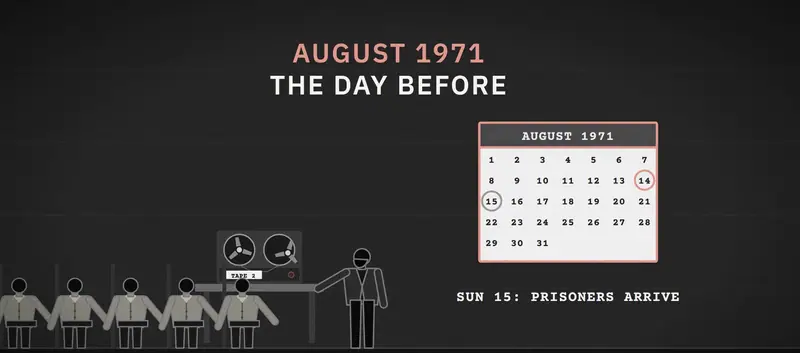 1 Told they could create fear: the Stanford Prison Experiment
Stanford's prison guards were told they could create fear. The tape survives. It was the day before the prisoners arrived, in August 1971.127
Watch at 0:00 -
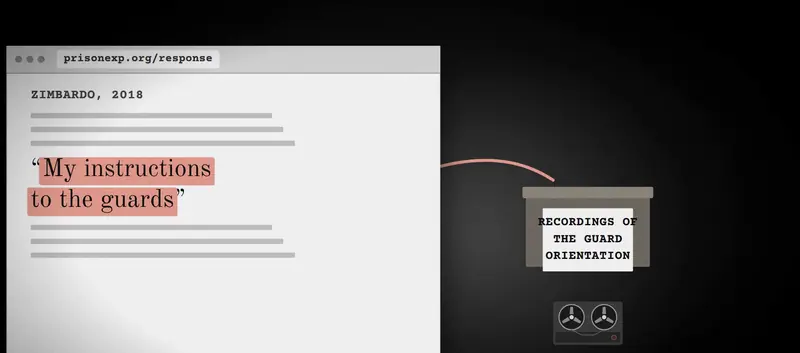 2 The orientation tape
Zimbardo called these his instructions to the guards. He pointed to the recordings himself.7
Watch at 2:36 -
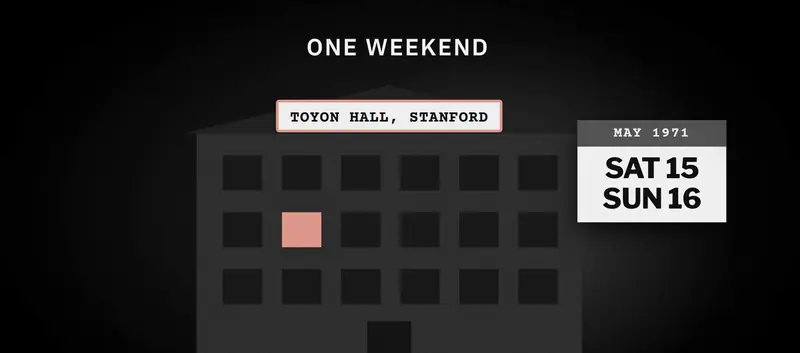 3 The dorm prison before Stanford
Three months earlier, students in one of Zimbardo's classes ran a prison of their own. It lasted one weekend, the fifteenth and sixteenth of May 1971, in a dorm called Toyon Hall.2
Watch at 3:36 -
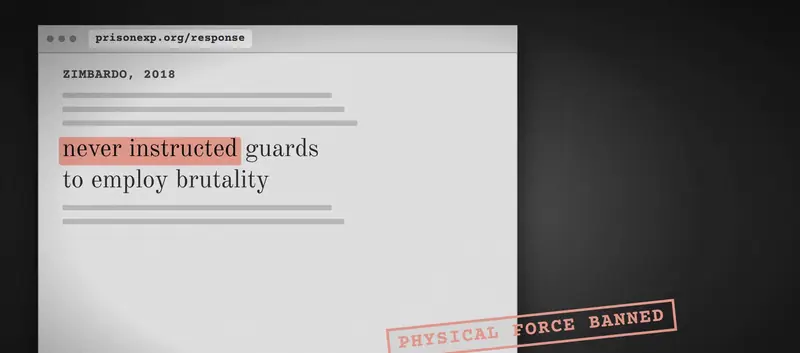 4 Zimbardo's side
But Zimbardo said the guards were never told to be brutal. He wrote that the team never instructed guards to employ brutality, and banned physical force outright.7
Watch at 4:36 -
 5 What students read
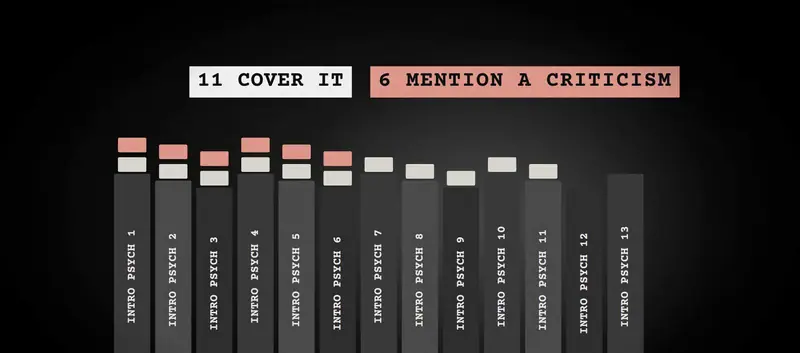
In 2014, a psychologist named Griggs checked thirteen introductory psychology textbooks. Eleven covered the Stanford study. Only six of those mentioned any criticism of it.6
Watch at 8:30


What happened in the Stanford prison experiment?
In August 1971, volunteers agreed to play guards or prisoners in a simulated prison at Stanford, for fifteen dollars a day. The study was planned for two weeks and stopped after six days. Its 1972 report said many volunteers stopped telling their prison role apart from themselves.
The guards met for an orientation the day before the prisoners arrived. Zimbardo, the prison's Superintendent, told them they could not hit the prisoners, and then what they could create. In a note Le Texier found in the archive, the Warden, an undergraduate named David Jaffe, wrote that his job was to elicit tough guard behavior.
In 2019, Thibault Le Texier went through the study's archive and interviewed fifteen of its participants. His paper says the guards were given precise instructions on how to treat the prisoners. He also found that students in one of Zimbardo's classes had run a prison of their own three months earlier, in a dorm called Toyon Hall.
Zimbardo and his co-author Craig Haney answered their critics in 2018, before that paper came out. Zimbardo wrote that the guards were never told to be brutal. Haney said the guards followed no orders to be harsh, and that some pushed back when he told them to treat the prisoners more humanely.
In 2002, the BBC broadcast a prison study run by Haslam and Reicher, who took no leadership role. Their guards did not take to the role. Its authors say it came close to recreating the tyranny of the Stanford study.
Read the start of the transcript
Transcript
Stanford's prison guards were told they could create fear.
The tape survives.
It was the day before the prisoners arrived, in August 1971.
The man speaking was Philip Zimbardo, who ran the study.
The study's own report says the guards got only minimal guidelines.
His critics say that for nearly half a century, his study has been read one way.
Questions
Is the Stanford prison experiment real?
Yes. It ran at Stanford in August 1971, and its authors wrote it up in a 1972 report. It was planned for two weeks and stopped after six days. What is argued over is how much the guards were steered.
Is the Stanford prison experiment accurate?
The study happened, but the famous reading is disputed. The 1972 report says the guards got minimal guidelines. Le Texier's 2019 archive study says they got precise instructions. Zimbardo wrote in 2018 that they were never told to be brutal.
What is the new Netflix Stanford prison experiment?
The New Stanford Prison Experiment is a six episode Netflix series that premiered on October 21, 2026. The Stanford Daily reports that thirty volunteers enter a decommissioned section of a real detention center. We have not reviewed it. This page is about the 1971 study.
Did Zimbardo answer Le Texier?
Zimbardo replied to his critics in 2018, including Le Texier's French book on the study. Le Texier's paper came out a year later. Zimbardo died in October 2024, at 91.
Sources (12)
Show all 12 sources
- Haney, C., Banks, W. C., and Zimbardo, P. G. (1972). Interpersonal Dynamics in a Simulated Prison. Technical report, Stanford University, for the Office of Naval Research. doi.org/10.21236/ad0751041
- Le Texier, T. (2019). Debunking the Stanford Prison Experiment. American Psychologist, 74(7), 823 to 839. doi.org/10.1037/amp0000401
- Haslam, S. A., Reicher, S. D., and Van Bavel, J. J. (2019). Rethinking the nature of cruelty: The role of identity leadership in the Stanford Prison Experiment. American Psychologist, 74(7), 809 to 822. doi.org/10.1037/amp0000443
- Haslam, S. A., and Reicher, S. D. (2012). Contesting the "nature" of conformity: What Milgram and Zimbardo's studies really show. PLoS Biology, 10(11), e1001426. doi.org/10.1371/journal.pbio.1001426
- Reicher, S., and Haslam, S. A. (2006). Rethinking the psychology of tyranny: The BBC prison study. British Journal of Social Psychology, 45(1), 1 to 40. doi.org/10.1348/014466605X48998
- Griggs, R. A. (2014). Coverage of the Stanford Prison Experiment in introductory psychology textbooks. Teaching of Psychology, 41(3), 195 to 203. doi.org/10.1177/0098628314537968
- Zimbardo, P. G. (2018). Philip Zimbardo's response to recent criticisms of the Stanford Prison Experiment. prisonexp.org. prisonexp.org
- Haney, C. (2018, June 25). Statement by Craig Haney. prisonexp.org. prisonexp.org
- Ratnesar, R. (2011). The menace within. Stanford Magazine. stanfordmag.org
- The Stanford Daily (2018, November 13). Unchaining the Stanford Prison Experiment: Philip Zimbardo's famous study falls under scrutiny. stanforddaily.com
- The Stanford Daily (2024, October 23). Remembering Philip Zimbardo. stanforddaily.com
- Alderson, A. (2026, October 20). Netflix series inspired by Stanford Prison Experiment premieres Wednesday, reimagines infamous study. The Stanford Daily. stanforddaily.com


