
Outrun Your Own Brain
A free runner where every door is a real psychology study.

A game by Under the Behavior
Screenshots
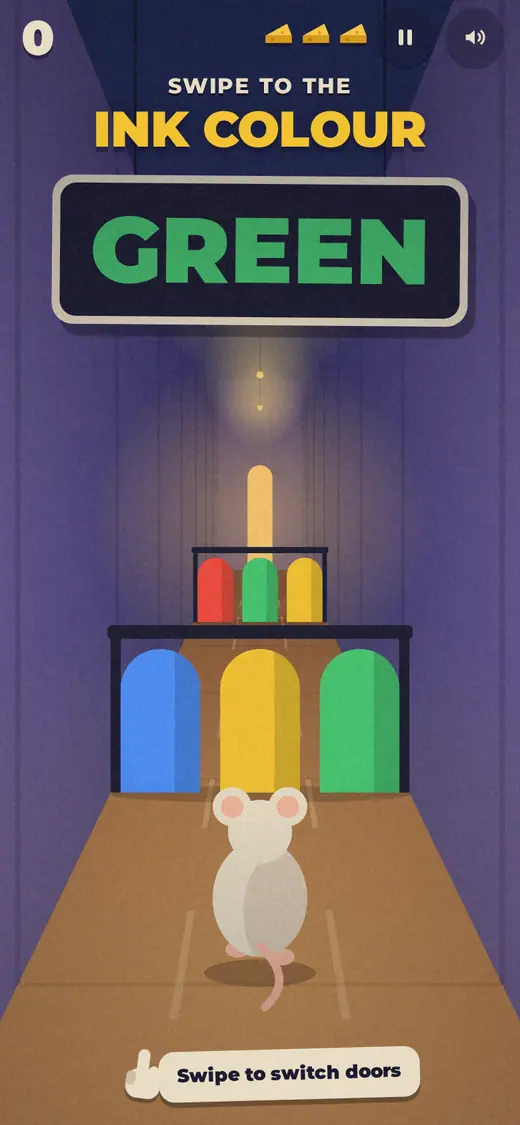
Pick 1 of 3 doorsThe run: a word, three doors, one swipe. 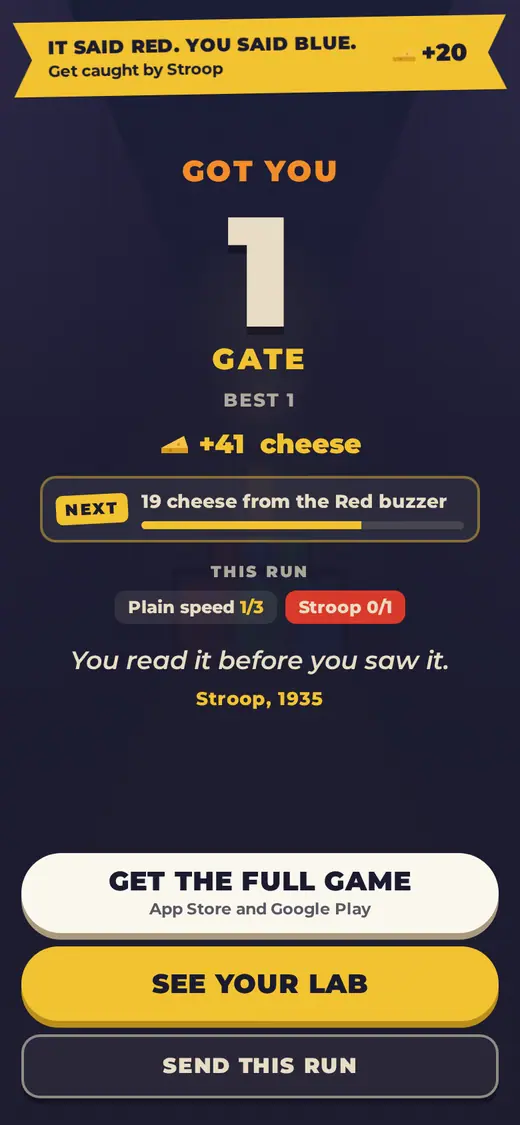
Meet what got youThe crash screen names the study and its year. 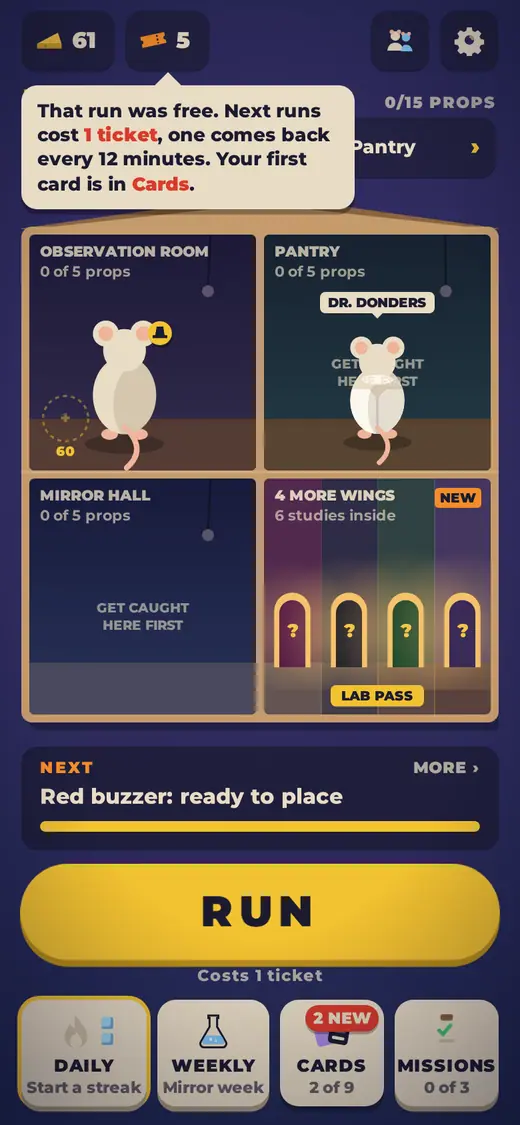
Fill your labCheese from every run builds your lab. 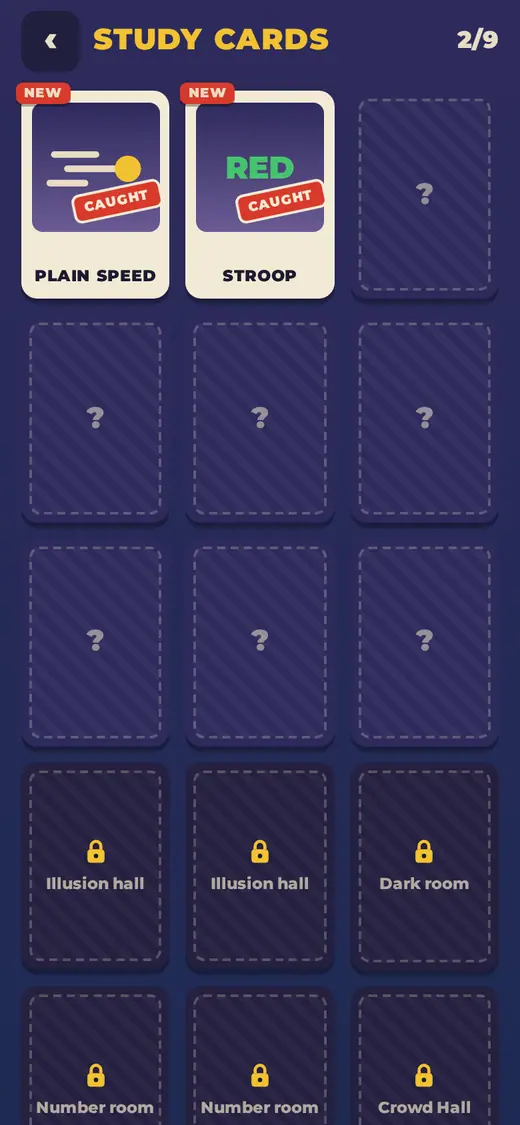
Collect the studiesEvery effect you meet becomes a study card.


How it works
- 1
Swipe to a door
Each gate has three doors and one rule. Swipe left or right, or tap a side.
- 2
Dodge the trick
The doors use real effects: a word in the wrong ink, arrows that point the other way.
- 3
Meet the study
When an effect catches you, the game shows the study behind it.
Real studies behind the doors
Every effect in the game comes from a published study. When one catches you, the crash screen names it.
Stroop effect
“You read it before you saw it.”
Stroop, 1935Flanker effect
“The neighbours pulled your thumb along.”
Eriksen & Eriksen, 1974Simon effect
“Your thumb goes where it's shown.”
Simon & Rudell, 1967Switch cost
“Switching rules costs your brain a beat.”
Rogers & Monsell, 1995Attentional blink
“The second cheese came during your brain's blink.”
Raymond, Shapiro & Arnell, 1992Change blindness
“The lanes changed in the blink. You missed it.”
Rensink, O'Regan & Clark, 1997SNARC effect
“Your brain files small numbers on the left.”
Dehaene, Bossini & Giraux, 1993Müller-Lyer illusion
“The fins stretched it. Your eyes believed them.”
Müller-Lyer, 1889Asch conformity
“The crowd went the wrong way. You went with them.”
Asch, 1951The cardboard cat
“A giant cardboard cat walked right past you.”
Simons & Chabris, 1999
Sources (10)
- Stroop, J. R. (1935). Studies of interference in serial verbal reactions. Journal of Experimental Psychology. doi.org/10.1037/h0054651
- Eriksen, B. A., & Eriksen, C. W. (1974). Effects of noise letters upon the identification of a target letter in a nonsearch task. Perception & Psychophysics. doi.org/10.3758/BF03203267
- Simon, J. R., & Rudell, A. P. (1967). Auditory S-R compatibility: The effect of an irrelevant cue on information processing. Journal of Applied Psychology. doi.org/10.1037/h0020586
- Rogers, R. D., & Monsell, S. (1995). Costs of a predictible switch between simple cognitive tasks. Journal of Experimental Psychology: General. doi.org/10.1037/0096-3445.124.2.207
- Raymond, J. E., Shapiro, K. L., & Arnell, K. M. (1992). Temporary suppression of visual processing in an RSVP task: An attentional blink? Journal of Experimental Psychology: Human Perception and Performance. doi.org/10.1037/0096-1523.18.3.849
- Rensink, R. A., O'Regan, J. K., & Clark, J. J. (1997). To see or not to see: The need for attention to perceive changes in scenes. Psychological Science. doi.org/10.1111/j.1467-9280.1997.tb00427.x
- Dehaene, S., Bossini, S., & Giraux, P. (1993). The mental representation of parity and number magnitude. Journal of Experimental Psychology: General. doi.org/10.1037/0096-3445.122.3.371
- Müller-Lyer, F. C. (1889). Optische Urteilstäuschungen. Archiv für Physiologie, Supplement.
- Asch, S. E. (1951). Effects of group pressure upon the modification and distortion of judgments. In H. Guetzkow (Ed.), Groups, leadership and men. Carnegie Press.
- Simons, D. J., & Chabris, C. F. (1999). Gorillas in our midst: Sustained inattentional blindness for dynamic events. Perception. doi.org/10.1068/p281059
Get Lab Rat on your phone
The apps come out on November 19. On Android, pre-register on Google Play and you'll get it that day. For iPhone, tap the App Store button and we'll send you the link. Until then, the web game plays free in any phone browser.
Play now, freeQuestions
Is Lab Rat free?
Yes. The web game is free to play right here in your browser, with no account and nothing to install. Your progress is saved in this browser only. The iPhone and Android apps are free to download and play too, with optional purchases (Lab Pass and cheese packs) and optional ads you can choose to watch for a reward.
Which phones does it work on?
Any recent phone with a modern browser, like Safari on iPhone or Chrome on Android. Hold the phone upright. It also runs on a computer: use the arrow keys to switch doors.
When do the apps come out?
On November 19, on iPhone and Android. The Android app is open for pre-registration on Google Play: tap the Google Play button on this page and you will get it that day. For iPhone, tap the App Store button and leave your email, and we will send you the link the day it is out.
Is Lab Rat a real psychology test?
No. It is a game built on real effects. Each door uses a trick that a published study made famous, and the crash screen names that study. Your score is a game score; it says nothing about you.
Who made Lab Rat?
Under the Behavior, the channel behind this site. We tell the true stories behind famous psychology studies, and Lab Rat lets you run into some of those effects yourself.
Privacy Policy · Terms of ServiceGoogle Play and the Google Play logo are trademarks of Google LLC.